Industry Insights
A4A’s Response to Misleading and Incomplete Story from The New York Times
October 09, 2026
A4A has shared the following information with the New York Times to provide accurate data and crucial context to several of the topics mentioned in the story, How the Trump Administration Is Eroding Airline Passengers’ Rights, published on October 8, 2026. Unfortunately, the New York Times has chosen not to include vital information, to the detriment of consumers. We are pleased to share the following information for the record.
- Cash Compensation: Cash compensation was never an airline passenger right. Writing that this “right” was “rolled back” is false and misleading. In October 2024, Sec. Buttigieg announced an Advanced Notice of Proposed Rulemaking (ANPRM). This was a proposal looking into European-style compensation scheme that would compensate passengers beyond a refund for flight disruptions. That proposal never moved forward. Airlines already provide automatic refunds if the passenger chooses not to be rebooked—regardless of whether the significant delay or cancellation is within the carrier’s control—and also have competitive policies to reimburse for food, transportation and lodging for cancellations and significant controllable delays. Mandating additional cash compensation—beyond what airlines already provide—will drive up ticket prices, make air travel less accessible for price-sensitive travelers and negatively impact carrier operations. InterVISTAS released a report in 2024 indicating that if a European-style compensation scheme is implemented in the U.S., it could cost passengers $5.2 billion annually, reduce service and increase operational disruptions.
- Font Sizes & Ancillary Fees: Having all itemized parts of a ticket listed out in the same font size allows the customer to see each piece of the total cost of the ticket more clearly. Since 2011, carriers have been required to include all taxes and fees in an advertised airfare price. Airlines should not be mandated to minimize government-mandated taxes and fees with smaller font. Nearly 20% of an airline ticket cost is government-mandated taxes and fees. The Duffy DOT rule makes airline ticket costs more transparent, not less.
Further, the Biden DOT failed to establish that consumers are unable to obtain information about optional ancillary fees. To the contrary, consumers are well-aware of the existence of these fees. Airlines go to great lengths to make their customers knowledgeable about these service options and fees. In addition to the disclosures required by existing DOT regulations, airlines engage in competitive advertising and emphasize ancillary fee discounts and benefits when they promote their loyalty programs. The Biden DOT ancillary rule was a bad solution in search of a problem and deemed an illegal rulemaking by the courts.
U.S. airlines care deeply about the customer purchasing experience and invest heavily in their websites and mobile apps to ensure both transparency of all costs and ease of use for each customer with a purchase path tailored to that customer’s specific choices. Airlines already provide consumers with complete disclosure of all fees associated with air travel before they purchase a ticket. In fact, A4A carriers show side-by-side comparisons of what each fare type offers (or doesn’t offer), including bag fees:
Here’s Alaska’s interface: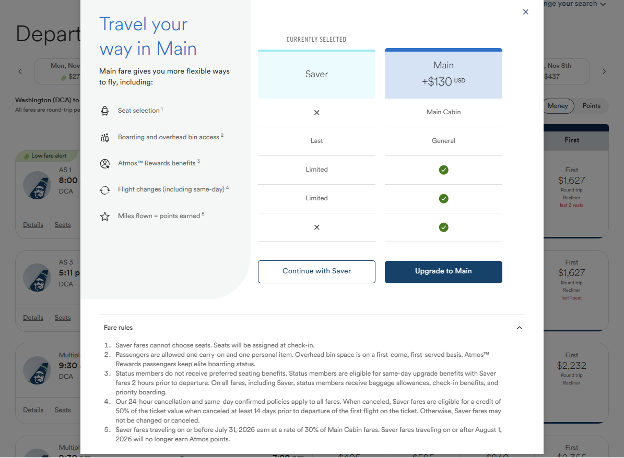
Here’s American’s interface: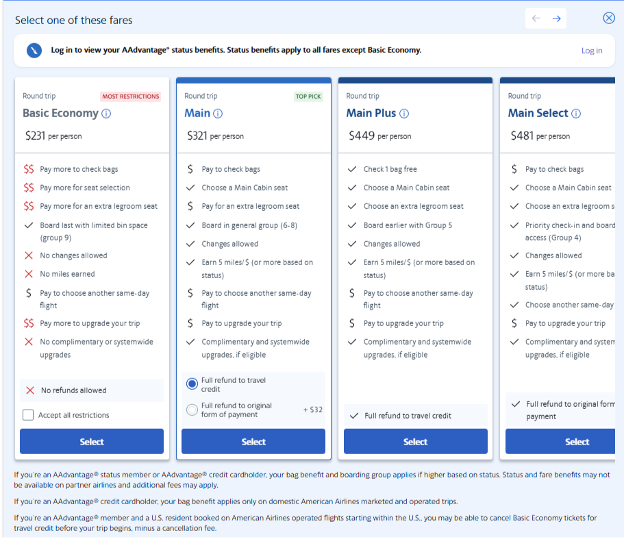
Here’s Delta’s interface: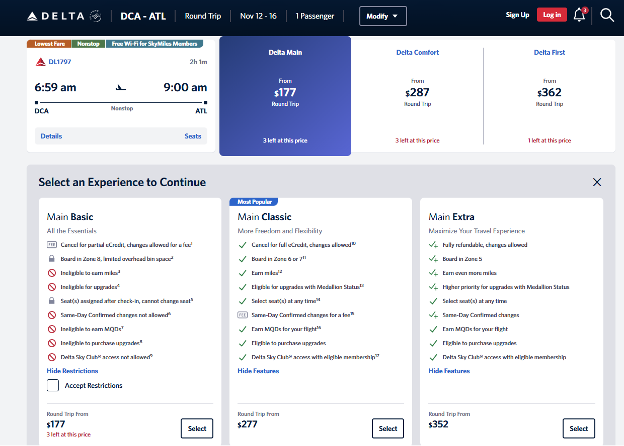
Here’s JetBlue’s interface: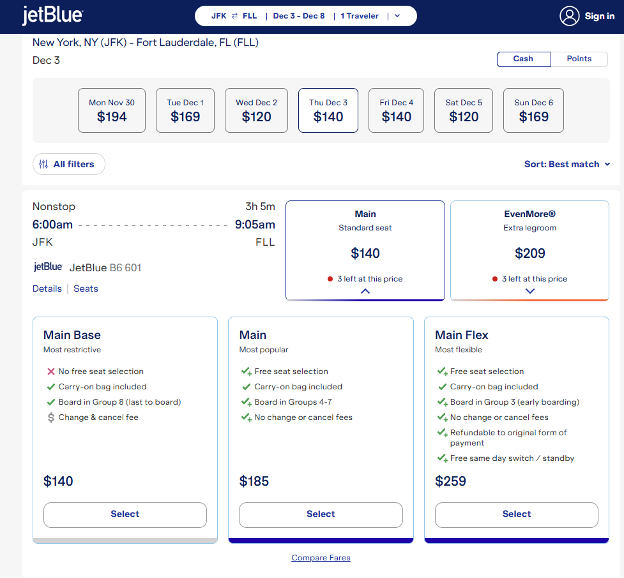
Here’s Southwest’s interface: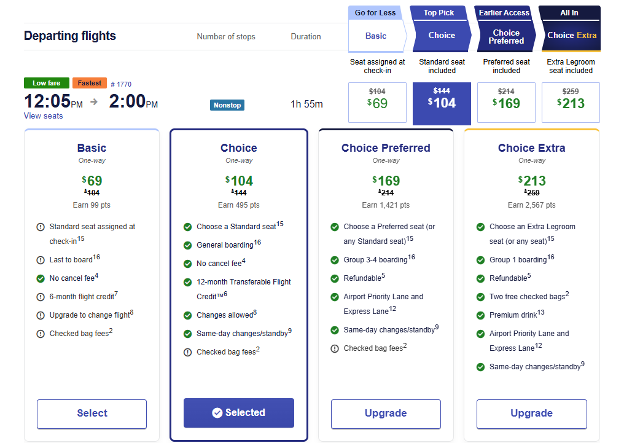
Here’s United’s interface: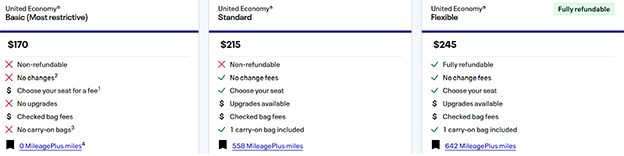
- Controllable vs. Uncontrollable Disruptions: The article also states “[DOT] has carved out more exceptions for flight disruption in which airlines would not need to compensate travelers.” As part of the bipartisan 2024 FAA reauthorization, Congress instructed DOT to reassess some causes of airline delays and cancelations and remove specific circumstances as airline causes. Before this change, airlines were held responsible for disruptions outside of their control including aircraft cleaning necessitated by the death of a passenger, medical emergencies, removal of unruly passengers, and weather concerns like wind shear or even volcanic ash. Airlines have competitive policies to mitigate impacts on passengers for delays/cancellations within their control (such as crew delays or mechanical issues/scheduled maintenance).
- Accessibility & Wheelchairs: A4A challenged the Biden/Buttigieg-era wheelchair rule because DOT established unlawful regulatory liability whereby airlines would be penalized for “Acts of God” like a wheelchair being struck by lightning on the tarmac during baggage loading, or a wheelchair being damaged by turbulence during flight. Each instance could result in a fine up to $75,000. This litigation is ongoing. Importantly, airlines would still pay to fix the wheelchair, regardless of the cause of the damage. The punitive fine for unfair liability is what A4A objects to.
- Family Seating: None of A4A’s passenger carriers charge a fee to sit children next to their parents, and each carrier has established effective policies to help ensure families sit together. A4A absolutely supports Congress’s mandate on adjacent seating for families on flights. However, the Biden/Buttigieg DOT went too far with its rulemaking, making it too prescriptive: For example, if a group of school children are on a flight, the Biden/Buttigieg rulemaking would have mandated Figure 1. Figure 2 shows a more reasonable seating arrangement, but the rule would have prohibited this seating configuration.
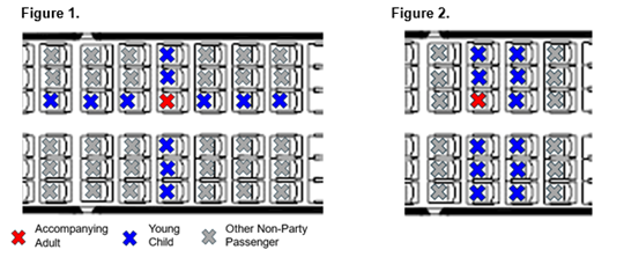
More importantly, the article falsely stated that DOT “has dropped early-stage efforts to let families sit together at no extra charge,” but that rulemaking is still ongoing and recently moved onto the next phase of government review before release.